
SEO
Keyword Variations and Synonyms: Optimizing Beyond the Exact Match
Google understands synonyms, but it does not treat every variation as the same search. Here is how to find, place and track the variants your customers actually type.
Google understands synonyms, but it does not treat every variation as the same search. Here is how to find, place and track the variants your customers actually type.
When Google shows guides, shops and videos for the same keyword, here is how to read the split and decide what to build.
Old pages drift into ranking for searches nobody planned. Here is how to use Search Console data to pick one clear primary keyword and re-center the page without losing what already works.
AI Overviews show far more for some searches than others. Here is what triggers them and how to sort your keywords by exposure.
No keyword is fully AI-proof, but some searches still earn clicks even with AI answers on the page. Here is how to find them in your own data, score them and keep the list current.

Pages ranking at positions 8 to 20 are your cheapest traffic gains. Here is how to find, score and improve them.
Many results pages are full of forums, outdated articles and thin pages. Here is a repeatable method for finding and beating them.
Autocomplete shows how real people phrase their searches. Learn how Google generates predictions, how to mine them systematically and what to do when they say something unflattering about your brand.

When your product creates a new category, keyword tools return zeros. Here is how to rank for the problems people already search, build demand for the category name and track it as it grows.

No AI platform publishes prompt data, but your customers have been telling you their questions for years. Here is how to find, test and prioritise them.
Branded and non-branded keywords measure two different things: demand you already own and demand you still have to win. Here is how to separate, report and grow both.
Keywords are what you target; search queries are what people actually type. Here is why the difference matters for SEO and PPC, and how to use both.
An SEO content strategy decides which topics you cover, in what order and why. Here is a practical framework to build one that earns traffic and revenue.

A brand-new site has no links, no history and no data. This 90-day plan shows what to set up, which keywords to target and what results to expect.
Your competitors already rank for keywords you are missing. A keyword gap analysis turns that data into a prioritised list of pages to improve or create.
Google Keyword Planner is free and built on Google data, but it was made for advertisers. Here is how to set it up and read it correctly for SEO.

Google Trends shows when, where and whether interest is growing. Learn how its data works and seven practical ways to use it for SEO and content.

Zero search volume rarely means zero searchers. Learn when zero-volume keywords bring valuable leads, when they do not and how to find the good ones.
Commercial investigation keywords come from people comparing options before they buy. Learn how to find them and create pages that earn a place on the shortlist.

A content gap analysis shows which topics your competitors cover and you do not, and where your existing pages fall short. Here is a practical process for 2026.
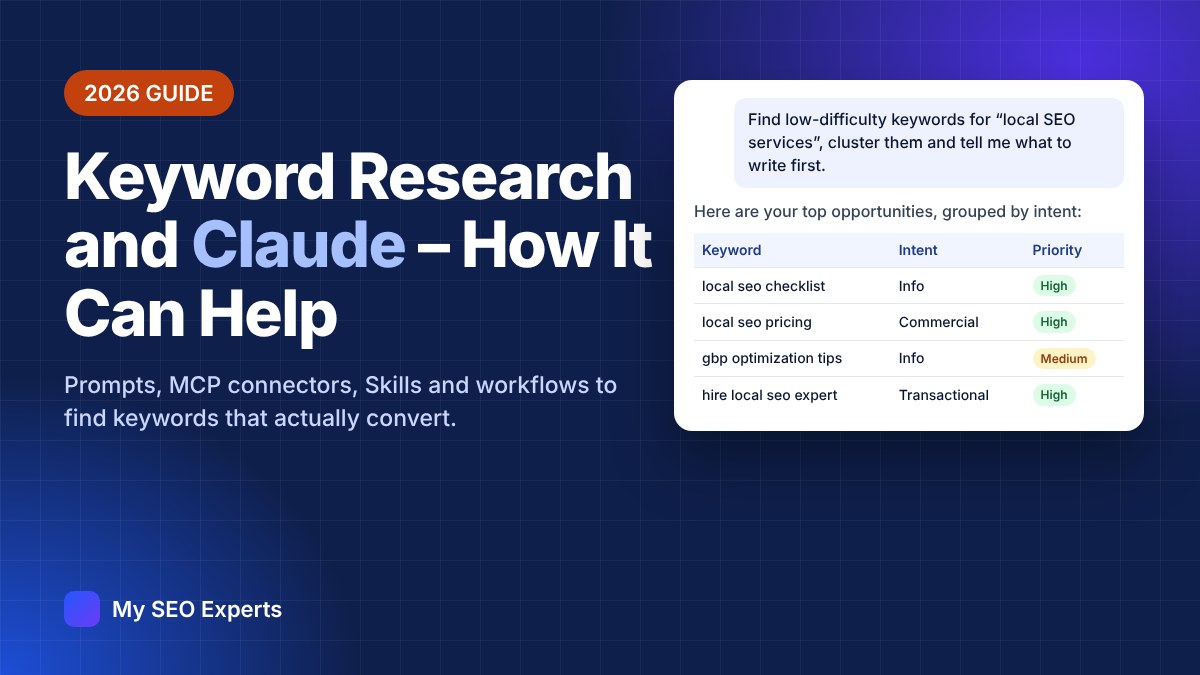
How to use Claude for keyword research in 2026 — connect real data with MCP, build a repeatable Skill and use 8 proven workflows with copy-paste prompts.
A practical, step-by-step keyword research process for 2026: where to find ideas, how to prioritise them and how to turn them into a content plan.
A clear guide to the types of keywords in SEO, with examples, a classification framework and the page type each keyword needs.

An SEO strategy turns scattered tactics into a plan tied to business goals. Here is a practical, step-by-step process for building one in 2026.
Search intent is the reason behind every query. Learn the main types, how to read intent from the results page and how to optimise your content for it.
Long-tail keywords are specific, lower-volume searches with clear intent. Here is how to find them, judge them and use them effectively.
Keyword difficulty scores help you prioritise, but they are estimates. Learn how they are calculated and how to combine them with your own SERP analysis.
Search volume is one of the first numbers you see in keyword research and one of the most misunderstood. Here is how to find it and read it correctly.
Keyword clustering turns a messy keyword list into a clear content plan. Learn how to group keywords by intent and SERP overlap, manually or with tools.
Seed keywords are the short, core terms every keyword research project grows from. Learn how to find the right ones and expand them into a full list.
Question keywords reveal exactly what your audience wants to know. Learn how to find them, prioritise them and write answers that get surfaced in search and AI results.
A keyword map tells you which page targets which keywords. Learn how to build one, use it to fix cannibalization and plan new content.
No articles match your search. Try another word or topic.
Get a free, no-obligation proposal tailored to your goals and budget.
Answer 3 quick steps and our experts will send a tailored proposal.