Every successful SEO campaign starts with the same question: what are people actually typing (or saying) when they look for what you sell? Keyword research is how you answer it. Get it right and every page you publish has a clear job, a real audience and a realistic chance of ranking. Get it wrong and you can spend months creating content nobody searches for.
Keyword research has also changed. In 2026, searches happen in Google, in AI Overviews and AI Mode, on YouTube, on marketplaces and in chat assistants. Volume alone is no longer a good enough reason to target a term. What matters is whether a keyword reflects a real need you can meet better than the pages already ranking.
This guide walks you through a practical, repeatable keyword research process: where to find ideas, how to judge them, how to group them into pages and how to turn the final list into a content plan your team can act on.
Key Takeaways
- Keyword research is about understanding demand and intent, not just collecting high-volume terms.
- Start with your own data (Search Console, sales and support questions) before you open a third-party tool.
- Judge every keyword on four things: intent, business value, difficulty and what the results page already looks like.
- Group closely related keywords into one page so you do not create competing pages for the same topic.
- Treat search volume figures as estimates; different tools often show different numbers for the same keyword.
- Revisit your keyword list regularly, because search behaviour and SERP layouts keep shifting.
What Is Keyword Research?
Keyword research is the process of finding the words and phrases your potential customers use in search engines, then deciding which of them your website should target and with which page. It sits at the heart of any SEO strategy, because it connects what people want with what you publish.
Google itself frames it in simple terms in its starter guide for site owners:
“Think about the words that a user might search for to find a piece of your content.”
— Google Search Central, SEO Starter Guide
The same guide notes that Google's language matching systems are sophisticated and can relate a page to many queries. In practice that means you do not need to repeat an exact phrase dozens of times. You need to cover the topic clearly, using the language your audience uses.
Why Keyword Research Still Matters in 2026
With AI-generated answers on many results pages, some marketers question whether keywords still matter. They do, for three reasons:
- Keywords reveal demand. They show which problems people are trying to solve and how often.
- Keywords reveal language. Customers rarely describe products the way your internal team does.
- Keywords reveal intent. The words around a topic ("best", "how to", "near me", "price") tell you what kind of page will satisfy the searcher. Our guide to search intent covers this in depth.
Google also states that there are no special extra requirements to appear in AI Overviews or AI Mode, and that normal SEO best practices still apply. Those features may use a "query fan-out" technique, running related searches across subtopics. That makes broad, well-organised topic coverage, built on solid keyword research, more valuable rather than less. See our article on getting cited in Google AI Overviews for more.
Core Keyword Metrics Explained
Before you start, it helps to know what each common metric means and how much weight to give it.
| Metric | What it tells you | How to use it |
|---|---|---|
| Search volume | Estimated monthly searches for a keyword | Use for relative comparison, not as an exact traffic forecast |
| Keyword difficulty | A tool's estimate of how hard it is to reach page one | Compare within the same tool; each vendor calculates it differently |
| Search intent | What the searcher wants: information, a specific site, a comparison or a purchase | Decides the page type you create |
| Cost per click (CPC) | What advertisers pay per click in Google Ads | A proxy for commercial value |
| SERP features | AI Overviews, local packs, videos, shopping results and more | Shows how many organic clicks may be available |
| Trend | Whether interest is rising, falling or seasonal | Helps you time content and spot emerging topics |
A note on volume: Google's own Keyword Planner documentation says keywords with very low search volumes, or keywords considered sensitive, are not discoverable or forecastable. Google Trends, meanwhile, shows interest on a relative 0–100 scale rather than absolute numbers. Use both as directional signals.
How to Do Keyword Research: Step by Step
Here is the process we use for client websites. It works for a ten-page local business site and for a large ecommerce catalogue.
- Define goals and audience. Write down what you sell, who buys it and which actions matter (calls, quote requests, sales, sign-ups). Keywords only matter if they lead toward those goals.
- List seed topics. Brainstorm 10–20 broad topics that describe your products, services and the problems you solve. These are your starting points, not your final targets.
- Mine your own data. Open the Performance report in Google Search Console and look at the queries you already get impressions for. Queries with many impressions but low clicks or positions between 8 and 20 are often quick wins. Our Google Search Console guide explains the report.
- Collect customer language. Review sales calls, support tickets, reviews, live chat logs and forums such as Reddit. These sources surface phrases and questions that tools often miss.
- Expand with tools. Enter your seed topics into Google Keyword Planner, Google Trends and a third-party tool such as Semrush or Ahrefs. Export related keywords, questions and long-tail variations.
- Check the SERP manually. Search your most promising keywords. Note what type of page ranks (guides, product pages, local listings, videos), whether an AI Overview appears and who the ranking sites are.
- Classify intent. Tag every keyword as informational, navigational, commercial or transactional. Our post on types of keywords gives examples of each.
- Score and prioritise. Rate each keyword for business value, intent fit, difficulty and opportunity. A simple 1–3 score for each column works well.
- Cluster and map. Group keywords that share the same intent and would be answered by the same page. Assign each cluster to one URL, either existing or new.
- Build the content plan. Turn each cluster into a brief with a primary keyword, supporting terms, questions to answer and the internal links the page should include.
Using AI tools in your research
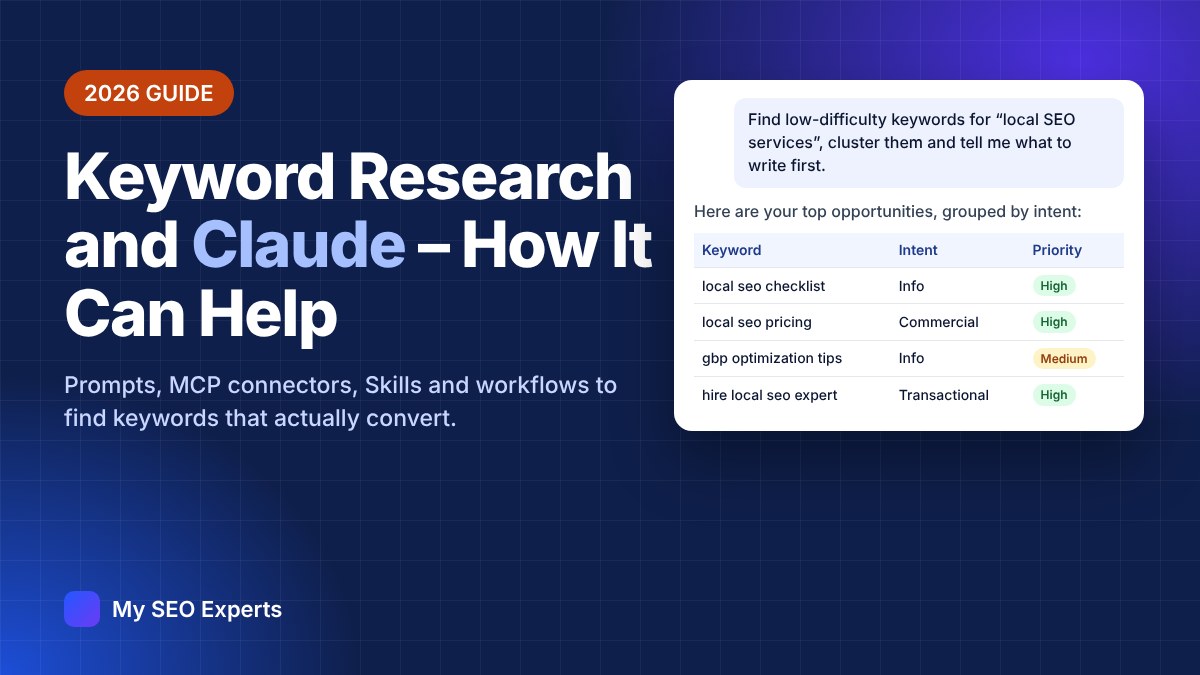
AI assistants are useful for brainstorming seed topics, grouping keywords and drafting briefs. They are not a reliable source of search volume data. Use them to speed up thinking, then validate with real data. We explore this in more detail in Keyword Research and Claude – How It Can Help.
How to Prioritise Keywords
A long list is easy to produce. A prioritised list is what actually drives results. The scoring grid below keeps decisions consistent.
| Factor | Score 3 (high) | Score 2 (medium) | Score 1 (low) |
|---|---|---|---|
| Business value | Directly linked to a service or product | Related problem your offer helps with | Loosely related topic |
| Intent fit | Searchers are ready to compare or buy | Searchers are researching options | Purely informational, early stage |
| Ranking difficulty | Results include sites similar to yours | Mix of strong and moderate sites | Dominated by major brands or AI answers |
| Existing visibility | You already rank on pages 1–2 | You rank somewhere in the top 50 | No current visibility |
Add the scores and start with the highest totals. In most cases, a mid-volume keyword with strong commercial intent and achievable difficulty will deliver more revenue than a huge informational term you have little chance of ranking for.
Turning Keywords Into Pages
The biggest practical mistake in keyword research is treating every keyword as a separate page. Searches such as "keyword research guide", "how to do keyword research" and "keyword research process" share the same intent and should be answered by one strong page.
- One cluster, one URL. Prevents keyword cannibalization, where several of your pages compete for the same query.
- Pillar and cluster structure. Use a broad guide as a hub and link to more specific supporting articles. See our guide to pillar pages and topic clusters.
- Long-tail coverage. Specific, longer phrases often convert well and are easier to rank for. Learn how to find them in our long-tail keywords guide.
- Write for people. Use keywords naturally in the title, headings and body, but focus on answering the question completely. Our SEO content writing guide shows how.
Recommended Keyword Research Tools
You do not need every tool on the market. A free stack covers most needs for small sites; paid tools add competitor data and larger keyword databases.
- Google Search Console (free): real queries, clicks, impressions and positions for your own site.
- Google Keyword Planner (free with a Google Ads account): keyword ideas, volume estimates and cost data.
- Google Trends (free): seasonality and rising topics on a relative scale.
- Semrush or Ahrefs (paid): large keyword databases, difficulty scores and competitor gap analysis.
- The results page itself (free): autocomplete, People Also Ask and related searches.
Common Mistakes in Keyword Research
- Chasing volume over value. A high-volume keyword that does not match your offer brings traffic that never converts.
- Ignoring intent. Trying to rank a product page for a "how to" query rarely works, because Google is showing guides.
- Skipping the SERP check. Tools cannot fully show you how crowded a results page is with ads, AI Overviews and other features.
- Creating one page per keyword variation. This splits your authority and confuses search engines.
- Keyword stuffing. Google's spam policies describe keyword stuffing as filling a page with keywords to manipulate rankings. It harms readability and can hurt visibility.
- Treating research as a one-off project. Markets, products and search features change. Review your list at least every quarter.
- Never checking competitors. A competitive analysis often reveals valuable keywords you would not think of yourself.
Related Guides
- Types of Keywords in SEO (With Examples)
- Search Intent: What It Is and How to Optimize for It
- Long-Tail Keywords: How to Find and Use Them
Frequently Asked Questions
How long does keyword research take?
For a small business site, an initial round usually takes a few days. Larger sites need ongoing research, with a quarterly review of priorities and new opportunities.
Is free keyword research good enough?
Yes, for many small sites. Google Search Console, Keyword Planner, Google Trends and the results page itself provide a solid starting point. Paid tools mainly add competitor data and larger keyword databases.
How many keywords should one page target?
One primary keyword plus a cluster of closely related terms that share the same intent. If two keywords need different types of page, they belong on different URLs.
Are search volume numbers accurate?
They are estimates. Different tools use different data and models, and Google Keyword Planner does not show data for very low-volume or sensitive keywords. Use volume to compare keywords, not to predict exact traffic.
Do keywords still matter with AI Overviews?
Yes. Google says standard SEO best practices still apply to AI features. Keyword research helps you understand the questions and subtopics people search for, which supports visibility in both classic results and AI answers.
Conclusion
Good keyword research is less about finding magic words and more about understanding your customers. Start with the data you already own, expand with tools, check the real results pages, then group and prioritise keywords into a focused content plan. Repeat the process regularly and your site will grow around the searches that matter most to your business.
Want a keyword strategy built around revenue rather than vanity traffic? Our content writing team and SEO specialists can research, map and write it for you. Get a free, no-obligation quote today.